Talent Risk in Filled Roles: The Hidden Risk Inside “Filled” Roles
Talent Risk in Filled Roles is one of the most dangerous risks in business because it hides behind a comforting status: “role filled.”
In most organizations, vacancies receive immediate attention. Open roles are tracked, escalated, and discussed in leadership reviews. Hiring progress is monitored closely because an empty role is easy to see.
But once a role is filled, the conversation usually moves on.
That is where the hidden risk begins.
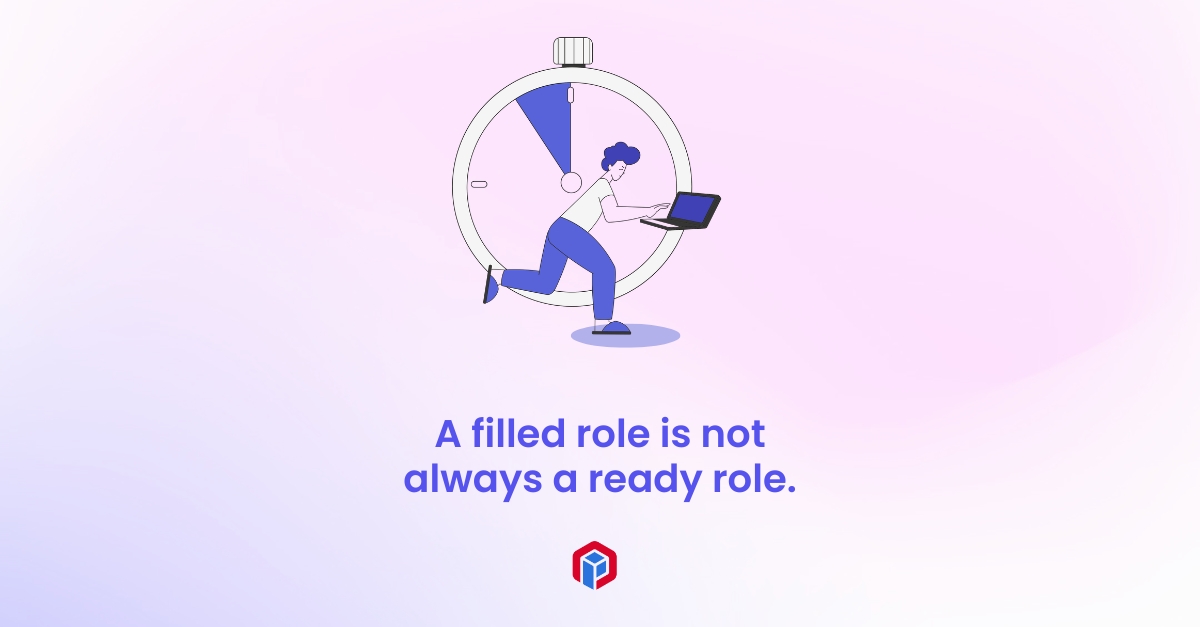
Because a filled role does not always mean a ready role. It only means someone is sitting in the position. The deeper question is different:
Can this person deliver what the role actually demands today and tomorrow?
That question matters more than ever. The World Economic Forum’s Future of Jobs Report 2025 found that 63% of employers identify skill gaps as a major barrier to business transformation between 2025 and 2030. It also found that 85% of employers plan to prioritize workforce upskilling.
So the real risk is not only empty roles.
The real risk is filled roles where readiness is assumed, capability is unclear, and business execution quietly starts to weaken.
A Filled Role Is Not Always a Ready Role
A role being filled is an administrative update.
It tells you someone has accepted the role, joined the team, or moved into the position. But it does not tell you whether the person is fully ready to perform at the level the role requires.
That difference is critical.
You may have a sales leader in place, but not one who can build new markets.
You may have a plant head in place, but not one ready for automation-led transformation.
You may have a project manager in place, but not one capable of managing ambiguity, client pressure, and cross-functional delivery.
On paper, the structure looks complete.
In reality, execution may already be carrying risk.
This is why business heads must shift attention from one question to another.
Instead of asking:
“Do we have someone in the role?”
They need to ask:
“Do we have the right level of capability in the role?”
That shift changes the quality of business decisions.
Where Talent Risk in Filled Roles Begins
Talent risk does not always begin with attrition. It does not always begin with a resignation, a vacancy, or a failed hire.
Sometimes, it begins when a capable person is placed into a role that has quietly outgrown their readiness.
The role may have changed because of:
- A new business strategy
- A larger team size
- A more complex customer base
- A technology shift
- A higher delivery expectation
- A new market or product line
- A change in compliance or quality demands
The employee may still be hardworking, loyal, and experienced. But the role may now require a different level of capability.
This is where Talent Risk in Filled Roles becomes difficult to spot.
The risk is not visible in the org chart.
The role is not vacant.
The reporting line is clear.
The designation exists.
The employee is present.
But readiness may still be missing.
And when readiness is missing in critical roles, business performance slowly starts paying the price.
The Visibility Gap Behind Business Execution
The biggest challenge is not that leaders do not care about talent.
They do.
The issue is that many organizations still do not have clear visibility into actual capability.
BearingPoint’s 2026 workforce transformation research found that 80% of HR leaders see high strategic value in HR technology, but only 14% actually connect to and act on the data generated by AI and analytics tools. The same study found that one-third of organizations still lack systematic HR data integration, limiting their ability to generate actionable skills and talent insights.
That is a serious signal.
Most organizations have HR systems. They have employee records, designations, performance ratings, compensation data, and reporting structures. But these systems often answer basic questions only:
- Who is in the role?
- What is their designation?
- Who do they report to?
- What was their last performance rating?
- What training did they complete?
These answers are useful.
But they are not enough.
Business heads need sharper answers:
- Who is truly ready for the role?
- Which critical roles are dependent on underprepared talent?
- Where are capability gaps affecting delivery?
- Which teams are over-reliant on a few high performers?
- Who can scale with the business, and who needs structured development?
This is where talent intelligence becomes essential. It moves organizations beyond employee data and into capability visibility.
Why Capability Gaps Quietly Slow Performance
Capability gaps do not always create immediate failure.
That is what makes them dangerous.
They start quietly.
Decisions slow down. Quality checks increase. Senior leaders get pulled into operational issues. Customers start noticing delays. Teams become dependent on one or two strong people. Managers begin compensating for weak role readiness without naming the problem.
Over time, this becomes a business drag.
McKinsey has reported that top performers in highly critical roles deliver 800% more productivity than average performers in the same role. McKinsey also notes that companies create disproportionate value when they clarify which roles and skills are most critical to business strategy and match best-fit talent to those roles.
That statistic should make every business leader pause.
If the right person in a critical role can create disproportionate value, the wrong fit can create disproportionate risk.
This is not about blaming the individual.
Often, the person is capable, committed, and talented. They may have performed well in a previous role. But the current role may demand a different level of capability.
That is why organizations must stop looking only at performance history and start looking at role readiness.
Performance tells you what someone has done.
Readiness tells you what someone can handle next.
Knowledge Dependency Makes Filled Roles More Fragile
There is another layer to this issue: knowledge dependency.
When a strong employee leaves, becomes unavailable, or moves into another role, the organization does not lose only a person. It loses context, judgment, relationships, decision history, shortcuts, role-specific know-how, and problem-solving memory.
The Panopto Workplace Knowledge and Productivity Report found that 42% of institutional knowledge is unique to the individual. The same report found that 60% of respondents said it was difficult, very difficult, or nearly impossible to obtain information vital to their job from colleagues.
This is exactly why filled roles can still be fragile.
If only one person knows how to solve a recurring issue, manage a key customer, handle a process exception, or make a critical technical judgment, the role may look stable but actually carry high business risk.
You usually see the problem only when something breaks:
- A key employee resigns.
- A project suddenly slows down.
- A customer escalation becomes harder to resolve.
- A plant, function, or region loses its informal problem-solver.
- A successor steps in but cannot operate at the required level.
By then, the risk is already active.
The smarter approach is to identify capability and knowledge dependency before it becomes business disruption.
When Full Teams Still Struggle to Deliver
A full team does not always mean a fully capable team.
This is one of the most uncomfortable realities in business execution.
A department can have the right headcount and still struggle with speed, ownership, quality, and decision-making. A function can be fully staffed and still fail to support growth. A leadership team can look complete and still lack the capability required for transformation.
That happens when organizations measure capacity but not readiness.
Capacity tells you whether people are available.
Readiness tells you whether people can deliver.
This difference becomes especially important during change. When markets shift, customers expect more, technology changes, or business models evolve, old role definitions become outdated quickly.
A person who was ready for yesterday’s role may not automatically be ready for tomorrow’s role.
That is why Talent Risk in Filled Roles must become a business conversation, not only an HR conversation.
Engagement and Execution Are More Connected Than They Look
Role readiness is not only about skills.
It is also about energy, alignment, ownership, and clarity.
Gallup’s State of the Global Workplace 2026 found that global employee engagement fell to 20% in 2025, its lowest level since 2020. Gallup also estimated that low engagement cost the world economy approximately $10 trillion in lost productivity, or 9% of global GDP.
This matters because disengaged or unclear talent creates execution leakage.
A role may be filled, but if the person in that role is not engaged, not aligned, not supported, or not fully ready, the business still carries risk.
That risk may not appear as a vacant seat.
It appears as slower decisions, weaker follow-through, missed handoffs, low ownership, and repeated escalation.
For business heads, this creates a simple but powerful point:
Headcount does not guarantee execution. Capability does.
What Market Examples Teach Us About Capability Blind Spots
History gives enough warnings.
Nokia had strong teams, strong brand power, and deep technical history. But INSEAD’s analysis of Nokia’s decline explains that even when results were strong, leadership was concerned that rapid growth had reduced agility and entrepreneurialism. Several decisions made between 2001 and 2005 were intended to restore that drive, but instead contributed to the beginning of decline.
The lesson is not that Nokia lacked people.
The lesson is that large organizations can appear strong on paper while missing the capability shifts that matter most.
McKinsey also shares an example of a global financial-services company that recognized its workforce was not aligned with future digital needs. Instead of looking only at hiring, the company expanded its talent approach and developed digital capability through a broader workforce strategy.
These examples point to the same truth.
Business decline rarely begins as an org chart problem.
It often begins when the organization cannot clearly see where capability is strong, where it is thin, and where the future demands more than the current structure can deliver.
Questions Business Heads Should Ask Before Risk Shows Up
To manage hidden role risk, organizations do not need to start with complex transformation.
They can start with sharper questions.
Which roles are critical to business continuity?
Not every role carries the same level of business risk.
Some roles directly affect revenue, customer delivery, operational continuity, compliance, product quality, transformation, or cost control. Start by identifying the roles where weak readiness can quickly affect business outcomes.
Who is ready, not just present?
Do not stop at headcount.
Review whether the person in the role has the required functional, technical, behavioral, and leadership capability. This is especially important for roles that have expanded due to growth, technology change, market pressure, or customer complexity.
Where is the business depending too much on one person?
Single-person dependency is a major hidden risk.
If only one employee knows how to solve a recurring problem, manage a key client, handle a process exception, or make critical decisions, the business is exposed.
Which successors can truly step in?
A succession plan is useful only when it shows readiness honestly.
A name on a succession chart is not enough. Organizations need to know whether the person can step in immediately, step in with support, or needs a structured development path.
What capability gaps are already slowing execution?
This is the most important question.
Do not ask only, “Who is underperforming?”
Ask, “Which missing capabilities are slowing business outcomes?”
That framing helps organizations move from blame to action.
How to Reduce Talent Risk in Filled Roles
Once the risk becomes visible, it becomes manageable.
Here are practical steps organizations can implement:
- Map critical roles first. Identify the roles that have the highest business impact.
- Define role readiness clearly. Go beyond job descriptions and define the real competencies needed for success.
- Assess people against role demands. Compare current capability with what the role requires.
- Track critical gaps. Focus on the gaps that affect execution, customer outcomes, quality, cost, or transformation.
- Identify knowledge dependency. Find roles where too much expertise sits with one person.
- Build targeted IDPs. Development plans should address specific role gaps, not generic training needs.
- Review readiness regularly. Capability changes with business context, technology, and strategy.
- Use talent intelligence, not just HR records. Systems should help leaders see readiness, risk, and movement.
This is where talent intelligence platforms like PeopleBlox become relevant. Not as another HR system, but as a way for organizations to build capability visibility, understand role readiness, and make better talent decisions before risk becomes visible in business results.
Talent Risk in Filled Roles is not always obvious.
It does not always show up as attrition.
It does not always show up as poor performance.
It does not always show up as a vacant role.
Sometimes, it shows up as delay, dependency, rework, weak succession, slow transformation, customer dissatisfaction, or leadership overload.
That is why business heads need to look beyond whether a role is filled.
They need to know whether the role is ready, whether the person is ready, and whether the organization has enough visibility to act before the risk affects execution.
Because filled roles may protect your org chart.
But only ready roles protect your business.
Next step: Start with your most critical roles. Identify where readiness is assumed, where capability is unclear, and where the business depends too heavily on a few people. That is where hidden talent risk is most likely sitting.